Object study 03 / vertical route
The route to your room
The climb is not a decorative detail. Understand the whole journey from arrival point to bedside before deciding whether a tower suits your stay.
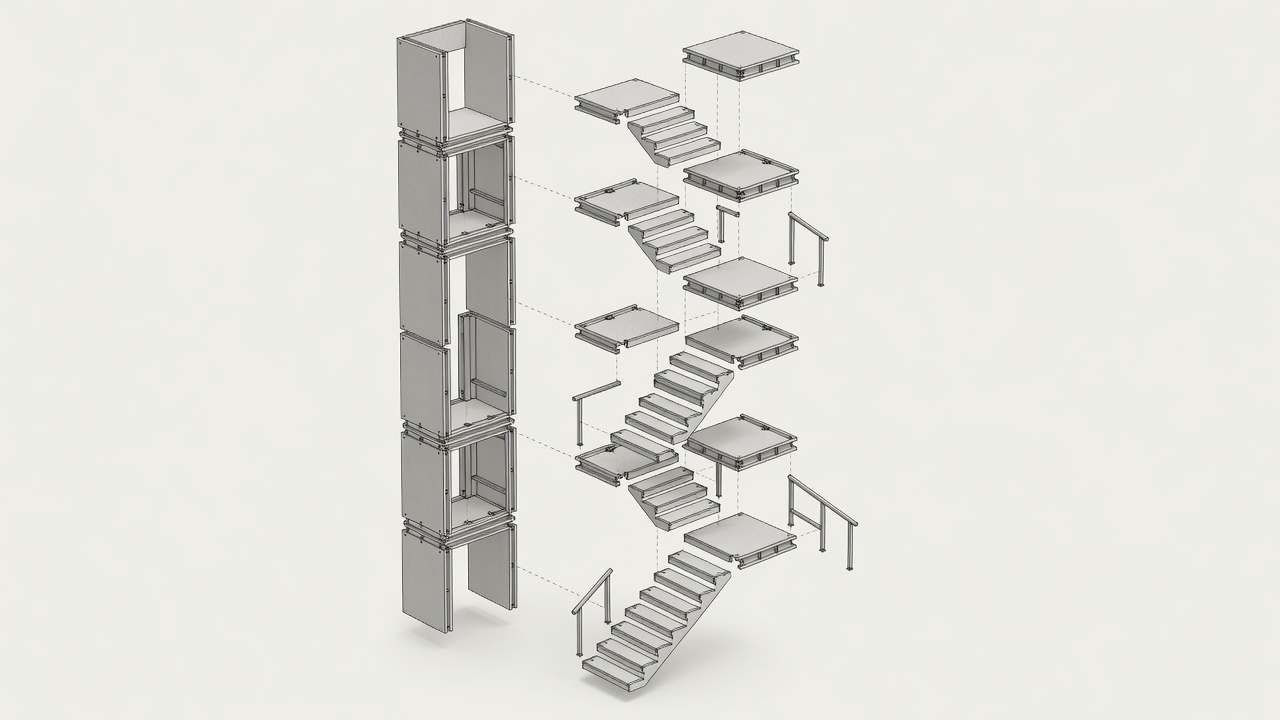
01 / arrival
Start before the entrance door
A useful access description begins at the place where you arrive, not at reception. The route from a station, taxi drop-off or parking space may include gravel, slopes, kerbs or gates. A former industrial site can have several entrances, and the most photogenic door is not necessarily the one used by overnight guests. Ask which entrance you should use and whether assistance must be arranged in advance.
Arrival timing also matters. A staffed hotel and a whole-tower holiday rental may handle late arrivals very differently. A key safe does not solve an inaccessible entrance, and an operator may not have someone on site overnight. Establish where keys are collected, how entry instructions are supplied, and what support is available if a lock, door or lift does not work as expected.
02 / ascent
“There is a lift” is a starting point
A lift can transform access, but the statement needs detail. Does it begin at a genuinely step-free entrance? Does it stop at the booked room’s level? Are there steps between the landing and the bedroom, or inside the accommodation itself? A lift serving the main hotel may not reach a roof terrace, mezzanine bathroom or upper sleeping platform.
If dimensions affect your stay, request the clear door opening, internal cabin dimensions and the usable space outside it. Describe your actual requirements rather than relying on a broad label. A wheelchair, mobility scooter, walking aid or child’s pushchair presents different considerations. Confirm the operator’s rules for any equipment you intend to bring, including safe storage and charging arrangements where relevant.
03 / stairs
Count the conditions, not just the steps
Two staircases with the same number of steps can feel very different. Width, tread shape, handrails, lighting and the frequency of landings all affect the route. Curved or spiral stairs may have narrower walking areas toward the centre. Open treads and visible drops can be uncomfortable for some guests even when the staircase is permitted and maintained.
Ask for recent photographs if the description is unclear. Consider the route while carrying luggage, returning after dinner or moving around when tired. If a bathroom is on another level from the bed, that separation matters at night. Architectural character is not a reason to dismiss a practical constraint, and no traveller should feel obliged to accept an unsuitable route simply because the building is historic.
04 / occupied space
Follow the route through the room
Reaching the bedroom door is only one part of access. Clearances around the bed, thresholds, door operation and bathroom fittings can determine whether the accommodation works. A room marketed as spacious may still have a tight turn at its entrance or a raised shower tray. Request information about the actual room category rather than a representative photograph of another suite.
Think about sensory conditions as well. Deep reveals, exposed surfaces and unusual floor layouts can create strong contrasts or uneven lighting. Alarm arrangements, clear signage and the availability of information in a usable format may be important. Explain the specific information you need; an accurate, limited answer is more useful than a vague reassurance that the building is suitable for everyone.
05 / emergency planning
Ask how the building works when plans change
Ordinary lift access does not establish an emergency evacuation route. Ask the operator how guests with your requirements are assisted during an alarm, whether any individual arrangements need to be agreed, and what happens during a power or lift failure. Do not assume that a standard passenger lift can be used in a fire. Follow the property’s current safety instructions rather than general travel advice.
Rules differ by jurisdiction and building use. Ireland’s Part M guidance, England’s Approved Document M and the European standard EN 17210:2021 offer different kinds of technical context; none is a simple global badge for a hotel. The Equality Act 2010 is relevant in Great Britain, not a universal statement of legal duties across Europe. This guide does not assess a property’s regulatory compliance.
Useful starting points: Approved Document M and the Equality Act 2010. For an individual stay, direct property information is essential.